
Why You Need to Use a Data-Backed AI-Optimized B2B Tech Press Release Format
Escalate PR has built a proven news format that helps B2B tech brands rank with large language models (LLMs)
Key Takeaways
- The B2B tech industry needs a new type of press release format to better serve LLMs.
- Escalate PR used a data-forward approach to determine the best structure. Order, sectioning, and clarity are the key ingredients.
- Our format works because it was created to assist LLMs to crawl, cite, and represent the releases accurately.
- We made you a free, downloadable Cheat Sheet you can use today to start getting cited more often by LLMs.
You’ve probably seen two things in the competitive B2B tech PR market.
- Other B2B tech PR firms that have released an all-new, free format, with zero methodology details.
- AI tools built to automatically spit out a new type of B2B tech press release, without answering the question of why the resulting document looks the way that it does.
Elephant in the room. No, Escalate PR wasn’t the first B2B PR tech agency to break the story about how the B2B tech industry needs a new press release format to get cited more frequently by LLMs. However, what we will be the first to do is prove the reasoning behind the new structure.
No regrets! But, let’s talk more about the current search landscape, AI, our reasoning, and our data.
Why Search Must Shift to Search and AI Visibility for Discoverability
“25% of search traffic is being replaced by AI answers in 2025 alone.” —Ben Harper, Founder, LLM Listed
Press releases aren’t irrelevant—they’ve gained a new audience. In 2025 and beyond, the PR experience needs to be engineered to inform buyers, engines, and journalists simultaneously. This requires a combination of unique narratives and informed structure.
Today’s AI assistants like ChatGPT, Gemini, Claude, and Perplexity act as distribution channels in their own right. When someone asks, “What’s new at [Brand]?” or “What does [Brand] offer?” these tools scan indexed content to build their answers.
The way your press release is formatted now determines whether your brand becomes part of that answer—or gets left behind.
Why We Rebuilt the B2B tech Press Release Format
AI systems no longer just pull from headlines or backlinks—they prioritize structured, factual content. Order, sectioning, and clarity of a press release directly influence whether it’s recognized and cited. In other words, structure = visibility.
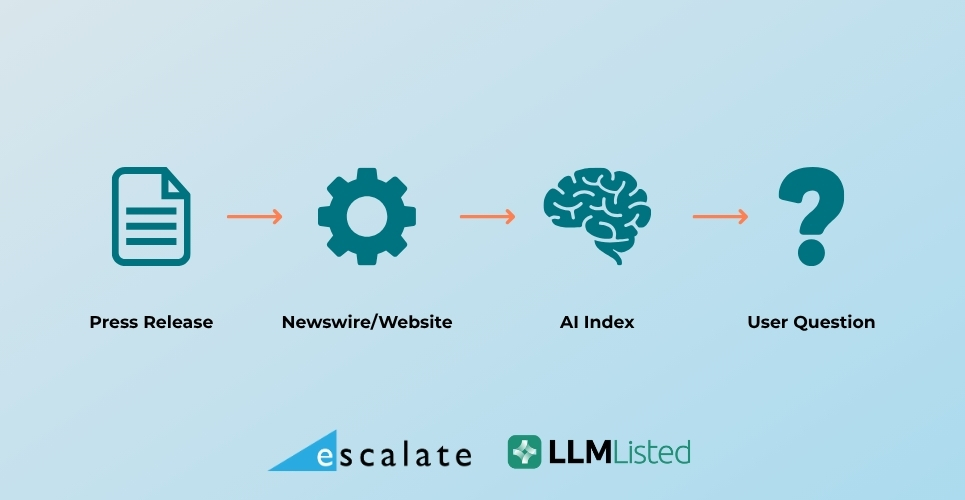
When written in that manner, press releases are surfaced faster, summarized better, and are often quoted verbatim by AI tools, allowing brands to maintain the narrative they want to project.
“You need to take advantage of any opportunity you can to control your brand’s PR narrative. Write the narrative you prize the most into your AI-optimized press releases to achieve this more regularly.” —Joel Richman, Co-Founder and Partner, Escalate PR
AI can bolster your brand’s preferred narratives for product launches, major events, and much more. Why wouldn’t you engineer everything to win out over your competition?
Escalate PR’s Data-Backed Framework for AI-Optimized Press Releases
Escalate PR partnered with LLM Listed to analyze more than 3,200 B2B tech press releases from 16 major distribution networks to understand what makes certain formats easier for AI models to crawl, cite, and represent accurately in responses.
We re-engineered the traditional B2B tech press release format to align with how LLMs read and rank content. Here’s the simplified version – the ten elements that consistently improve AI visibility and accuracy.
1. Headline & Subheadline
Do this: Lead with a clear benefit and a keyword that captures “what’s new.”
Result: AI uses this line to define the topic and correctly summarize your announcement. Placing the headline and subheadline in this position increases the likelihood of a correct summarization by 42%.
2. Dateline & Lead
Do this: Open with the 5Ws — who, what, when, where, and why.
Result: Helps AI establish context and credibility early. Contextual summaries are more 31% more inclined to include your dateline and lead in position two.
3. Bulleted “What’s New” Facts
Do this: Include 2–4 concise bullets right after your intro to summarize metrics, results, or integrations.
Result: AI treats these as the “event nucleus”—the most critical update in your release. This placement of bulleted “what’s new” facts means a 49% larger potential for inclusion in “latest updates” and “new feature” answers.
4. Why It Matters
Do this: Write one short paragraph tying your announcement to audience impact.
Result: Improves inclusion in benefit-focused AI answers and relevance scoring by 27%.
5. Features / Details
Do this: Add 3–7 structured bullets with key specifications, features, or differentiators.
Result: Keeps technical content easy to pull out mid-article, avoiding truncation or confusion, and earning a 38% higher extraction rate.
6. Proof / Data Point
Do this: Back up every claim with data, benchmarks, or real-world examples.
Result: Boosts perceived authority and factual trust by 46% in AI-generated answers.
7. Quotes
Do this: Include 1–2 concise, specific quotes after your proof or data.
Result: AI recognizes post-data quotes as credible, not promotional. It will be 22% more open to including your quotes in “expert opinion segments” if you do this.
8. FAQ Section
Do this: Add 2–3 pre-answered questions near the end (e.g., “When is this available?” “Who is it for?”)
Result: Increases “answerability”—the likelihood your content appears in direct responses by 58%
9. Boilerplate
Do this: End with a consistent, keyword-rich brand summary.
Result: Reinforces your brand identity in AI’s semantic memory, improving how it describes you. This ends up improved your brand association by 34%.
10. Contact
Do this: Close with clean contact info (name, email, and company).
Result: Reduces AI misattribution and ensures your release is read as complete and official. The error rate will plummet by 30% if you close in this manner.
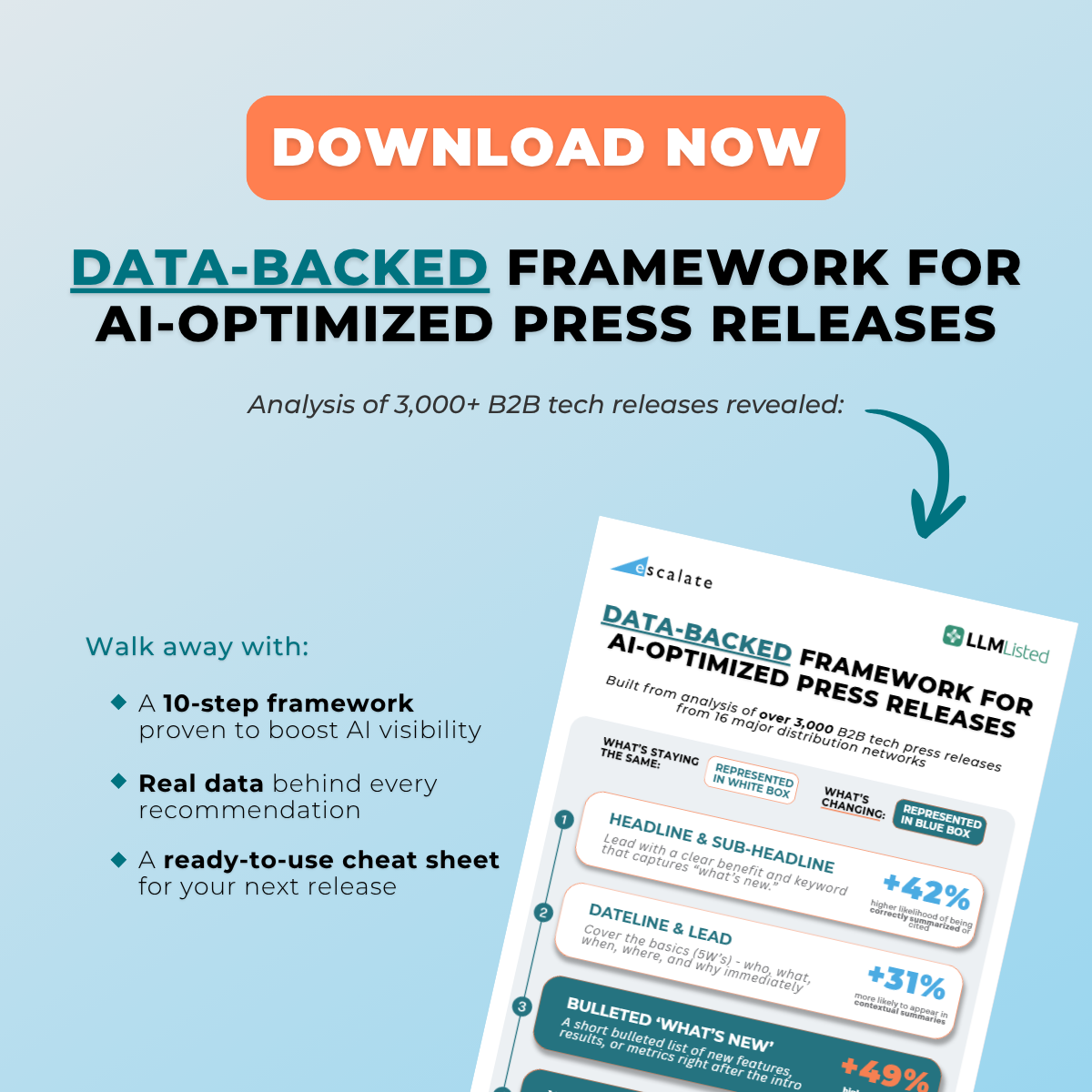
If you’re hoping to reference this easily for writing future B2B tech press releases, you’re in luck. We made a downloadable Cheat Sheet just for you.
This structure makes each release machine-readable, with short paragraphs, labeled sections, and real data points that humans can also enjoy easily, bettering overall interpretation.
What Research Methodology Did Escalate PR and LLM Listed Use?
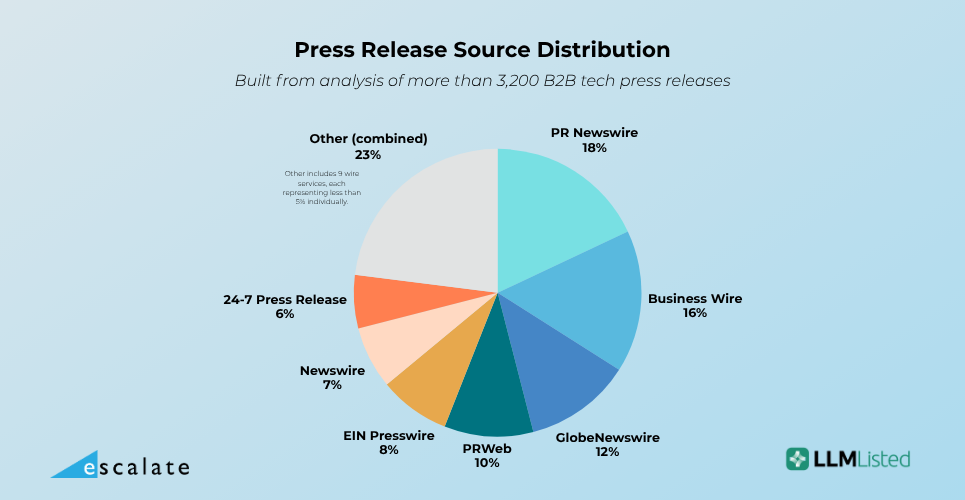
“We pulled press releases from the major newswires including PR Newswire, Business Wire, GlobeNewswire, PRWeb, EIN Presswire, Newswire, 24-7 Press Release Newswire, and other smaller players. We covered all the distribution market bases to ensure industry relevance and objectivity. This allowed us to complete a comprehensive data analysis that can help our clients and the sector in general.” – Ben Harper, Founder, LLM Listed
We didn’t guess. We measured.
Escalate PR and LLM Listed conducted a multi-phase study to understand what truly drives AI pickup.
1. Data Collection
We compiled press releases from 16 global networks, including PR Newswire, Business Wire, GlobeNewswire, PRWeb, EIN Presswire, and others, spanning six months.
2. Filtering for Relevance
Using AI-based categorization, we filtered for releases within the B2B category and excluded items that were too short or lacked structured data for analysis. This process identified releases that were long enough and contained sufficient information to be reliably evaluated.
3. Dataset Preparation
After filtering, 3,294 press releases remained in our dataset. Each release was broken down into its key structural components – such as headline, subheadline, lead paragraph, body, boilerplate, and contact information – to enable granular analysis.
4. AI Citation Testing
We then queried ChatGPT, Gemini, Claude, and Perplexity to determine whether each release appeared as a cited source within AI-generated responses to relevant industry or topic queries.
5. Analysis and Correlation
Finally, we compared content structure and stylistic elements with observed citation frequency across AI platforms. This allowed us to identify patterns in how press release design influences visibility and inclusion in generative-AI responses.
“At Escalate PR, anything we generate comes down to integrity, respect, and generating long-term success. We’re not flashy, we’re focused.” – Jason Ouellette, Co-Founder and Partner, Escalate PR
What Research Proves Actually Drives AI Pickup
Our findings show that structure sets the stage—but human engagement still teaches the algorithm what matters most.
When users searched for a brand by name and clicked through to structured releases, the visibility curve jumped dramatically.

In short: Structure prepares your content. Search and clicks make it memorable. Both matter.
How an AI-Optimized, Data-Backed Press Release Differs From Traditional Press Releases

In essence, it’s still a B2B tech press release, but now it’s formatted as structured data rather than a story.
What Does This B2B Tech Press Release Structure Mean for Marketing Leaders?
AI search is now influencing every stage of the B2B tech buyer journey. Here’s what our research reinforces:
✅ Clear structure makes your content machine-readable.
✅ Brand searches and clicks accelerate AI recognition.
✅ Consistent boilerplates strengthen how AI defines your brand.
✅ Schema and formatting reduce friction for indexing.
And the result? AI leads convert 7x faster than traditional search leads. As you can see, you need to use it if you want to remain relevant.
“Press releases have long been seen as the necessary evils of PR but today have taken on new importance for marketing programs in the era of AI search” – Jason Ouellette, Co-Founder and Partner, Escalate PR
At Escalate PR, we’ve always focused on measurable outcomes – not vanity metrics. Our data-backed AI-optimized framework ensures your announcements aren’t just seen, but understood and indexed by the systems shaping modern discovery.
Get Escalate PR’s Cheat Sheet